


Data from Argentina’s Population Census
Overview
This project was supported by the rOpenSci Champions Program 2023-2024, with Andrea Gomez Vargas as the main developer and Emanuel Ciardullo as co-author.
ARcenso is a package designed to democratize access to official data from Argentina’s National Population Censuses produced by the National Institute of Statistics and Census (INDEC).
Currently, historical census results (1960, 1970, 1980, 1991, 2001, 2010, and 2022) are scattered across physical books, PDFs, Excel files, or closed systems like REDATAM. This fragmentation makes it difficult to perform historical analysis or serial comparisons.
ARcenso aims to make this data available, homogenized, and ready to use in R.
Note: The available data is being added in stages. Currently, the package is in Stage 1.
Data Availability Roadmap
Geographic levels: National refers to country-level totals; Subnational refers to the 24 jurisdictions (23 provinces and the Autonomous City of Buenos Aires).
| Stage | Census years | Geographic level | Notes |
|---|---|---|---|
| 1 | 1970 | National and Subnational | Available |
| 1980 | National | Available | |
| 2 | 1960 | National | Coming soon — released by INDEC August 2026 |
| 1991 | National | Coming soon | |
| 2001 | National | Coming soon | |
| 3 | 2010 | National | Coming soon |
| 4 | 2022 | National | Coming soon |
| 5 | 1960 | Subnational | Coming soon |
| 1980 | Subnational | Coming soon | |
| 1991 | Subnational | Coming soon | |
| 6 | 2001 | Subnational | Coming soon |
| 2010 | Subnational | Coming soon | |
| 7 | 2022 | Subnational | Coming soon |
Installation
You can install ARcenso from GitHub with:
# install.packages("pak")
# if you do not have pak installed

pak::pak("SoyAndrea/arcenso")
Main functions
ARcenso provides three core tools:
arcenso_app(): Launches a Shiny app to query and visualize available tables interactively.check_repository(): Reports the tables currently available in the package based on search criteria.get_census(): Retrieves the actual datasets as a list of data frames.
Usage
First, load the library:
Interactive Exploration (Shiny App)
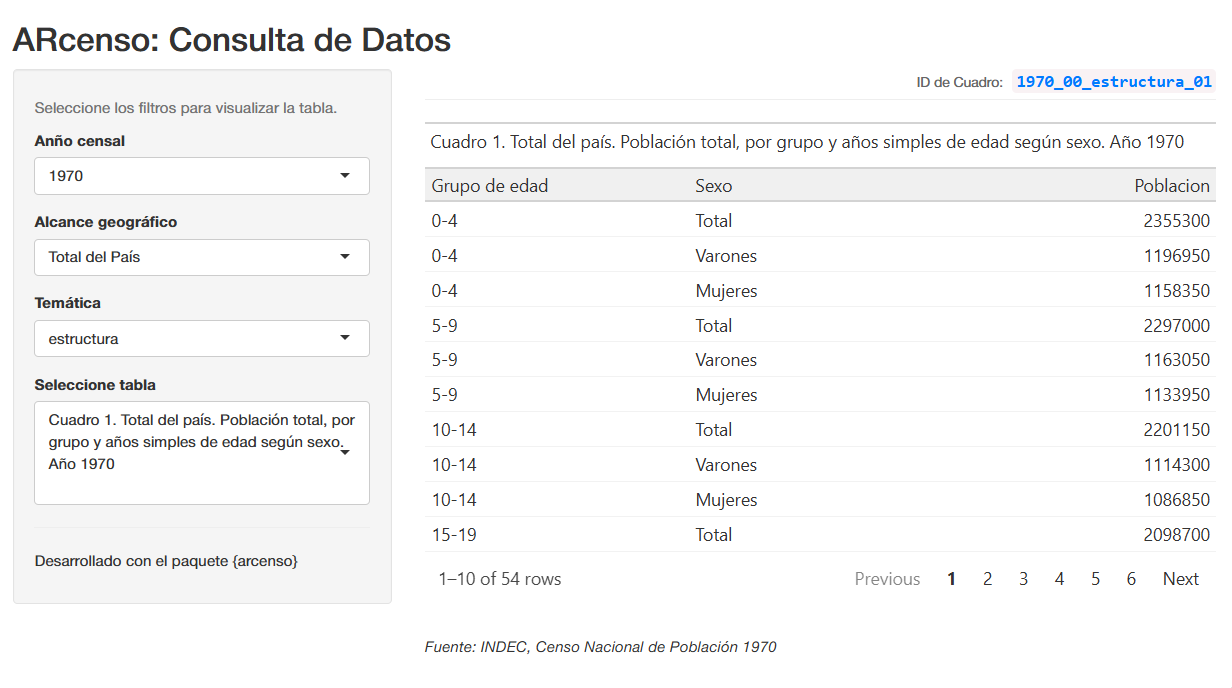
The easiest way to discover available data is through the built-in interface. You can browse tables, filter by geographic level, and copy the exact Table ID you need.
To launch the application locally, run:
# Launch the interactive Shiny application
arcenso_app()
Look at the interactive interface in action:
Exploring the Repository
Before downloading data, you can check which tables are available for a specific year, topic, and geographic level using check_repository():
# Check available tables for 1970 related to "educacion"
check_repository(
  year = 1970,
  topic = "educacion"
)
#> # A tibble: 75 × 3
#>    id_cuadro            cod_geo titulo
#>    <chr>                <chr>   <chr>
#>  1 1970_00_educacion_01 00      Cuadro 7. Total del país. Población de 10 y más…
#>  2 1970_00_educacion_02 00      Cuadro 8. Total del país. Población de 5 y más …
#>  3 1970_00_educacion_03 00      Cuadro 9. Total del país. Población de 5 y más …
#>  4 1970_02_educacion_01 02      Cuadro 3. Capital Federal. Población de 10 y má…
#>  5 1970_02_educacion_02 02      Cuadro 4. Capital Federal. Población de 5 y más…
#>  6 1970_02_educacion_03 02      Cuadro 5. Capital Federal. Población de 5 y más…
#>  7 1970_06_educacion_01 06      Cuadro 3. Provincia de Buenos Aires. Población …
#>  8 1970_06_educacion_02 06      Cuadro 4. Provincia de Buenos Aires. Población …
#>  9 1970_06_educacion_03 06      Cuadro 5. Provincia de Buenos Aires. Población …
#> 10 1970_10_educacion_01 10      Cuadro 3. Provincia de Catamarca. Población de …
#> # ℹ 65 more rows
Accessing Census Data
Once you have identified the table you need (either by ID or topic), use get_census() to retrieve the data.
Get specific table by ID (Recommended)
This is the most robust method for reproducible research.
# Download specific table (e.g., Structure of Population, National level)
census_data <- get_census(
  id = "1970_00_estructura_01"
)

census_data
#> # A tibble: 54 × 3
#>    grupo_de_edad sexo    poblacion
#>    <chr>         <chr>   <chr>
#>  1 0-4           Total   2355300
#>  2 0-4           Varones 1196950
#>  3 0-4           Mujeres 1158350
#>  4 5-9           Total   2297000
#>  5 5-9           Varones 1163050
#>  6 5-9           Mujeres 1133950
#>  7 10-14         Total   2201150
#>  8 10-14         Varones 1114300
#>  9 10-14         Mujeres 1086850
#> 10 15-19         Total   2098700
#> # ℹ 44 more rows
Search by topic and geography
You can also filter directly while requesting data.
# Download 1970 housing data for Tierra del Fuego (geo_code "94")
table_hab_94 <- get_census(
  year = 1970,
  topic = "habitacional",
  geo_code = "94"
)

table_hab_94
#> # A tibble: 4 × 4
#>   regimen_de_tenencia                 hogares personas cuartos
#>   <chr>                               <chr>   <chr>    <chr>
#> 1 Inquilino o arrendatario            784     2772     2132
#> 2 Ocupante en relación de dependencia 713     2388     2321
#> 3 Ocupante gratuito                   122     353      377
#> 4 En otro carácter                    39      154      107
Reference Dictionaries
Don’t know the geographic code for a province? Want to see all available topics? The package includes built-in datasets for quick reference.
Geographic Codes (geo_code)
Use geo_metadata to look up the INDEC codes required for filtering.
# View the full table of geographic codes
head(arcenso::geo_metadata)
#> # A tibble: 6 × 4
#>   cod_geo nombre_geo                      nombre_corto iso_3166_2
#>   <chr>   <fct>                           <chr>        <chr>
#> 1 00      Total del País                  Total        AR
#> 2 02      Ciudad Autónoma de Buenos Aires CABA         AR-C
#> 3 06      Buenos Aires                    Buenos Aires AR-B
#> 4 10      Catamarca                       Catamarca    AR-K
#> 5 14      Córdoba                         Córdoba      AR-X
#> 6 18      Corrientes                      Corrientes   AR-W
Available Topics (census_metadata)
You can list all unique topics available in the census metadata using standard R commands:
# List all unique topics

unique(arcenso::census_metadata$tema)
#> [1] estructura   fecundidad   educacion    conyugal     actividad
#> [6] migracion    composicion  habitacional vivienda
#> 9 Levels: estructura fecundidad educacion conyugal actividad ... vivienda
Data Source
The data included in ARcenso comes from the official population census publications by INDEC, Argentina’s national statistics institute. The original census tables are publicly available through their digital library and historical publications.
Note on citation: If you use this data in academic publications or research, we recommend citing both the ARcenso package (see Citation) and the original INDEC census publications as the primary data source.
Acknowledgments
This package was developed as part of the rOpenSci Champions Program (2023-2024).
We would like to express our special gratitude to:
Yanina Bellini Saibene (Program Leader) for her constant support, accompaniment, and guidance in structuring the project workflow.
Luis D. Verde Arregoitia for his invaluable mentorship, patience, and guidance throughout the development process.
Tamara Giselle Derner for designing the hex sticker and finding the perfect symbol to give the package a true national identity.
The rOpenSci community for fostering diverse participation, and the wider R community for their interest and company along the way.
Citation
If you use ARcenso in your research or projects, please cite it as follows:
Gomez Vargas, A., & Ciardullo, E. (2026). arcenso: Data from Argentina’s Population Census. R package version 0.2.1. Available at: https://soyandrea.github.io/arcenso/
You can also get the BibTeX entry by running:
citation("arcenso")Contributing
We welcome contributions in both English and Spanish. Please see our Contributing Guidelines for more details.
Code of Conduct
Please note that the arcenso project is released with a Contributor Code of Conduct. By contributing to this project, you agree to abide by its terms.